Every great adult was once a curious little child, sitting wide-eyed, listening to a story. Long before classrooms, textbooks, and school curriculam, stories were how families passed on their deepest wisdom from one generation to the next. Today, in a world full of screens and short attention spans, moral stories for kids are more important than ever.
At Little Scholar, the best playschool in Noida, we believe that character building begins not with rules and punishments but with stories. When a child hears about a greedy dog who loses his bone or a tortoise who never gives up, a quiet seed of wisdom is planted inside them. That seed grows slowly, but it lasts a lifetime.
In this blog, we will explore why moral stories for kids are so important for early childhood development and share five powerful, timeless tales you can tell your child tonight.
Why Moral Stories for Kids Matter More Than You Think
Before your child can read, reason, or debate, they feel. Stories speak directly to that emotional world. Here is what both research and real classroom experience tell us about the power of stories.
1. They Build Empathy in the Most Natural Way
When children follow a character through struggle and triumph, they experience emotions from someone else’s point of view. A child who hears about a lonely elephant finally accepted by his herd learns empathy without ever being lectured about it. The story does all the work quietly and gently.
2. They Teach Consequences Without Any Punishment
In moral stories for kids, the story itself teaches the lesson. The child sees what happens when someone lies, acts greedily, or gives up too soon. There is no scolding involved. The child simply watches the character face the natural result of their choices and understands it on their own.
3. They Improve Language and Communication Skills
Storytelling introduces new vocabulary, sentence patterns, and ideas in a way that feels completely natural to a young child. At Little Scholar, our educators use stories as a bridge between language development and emotional learning. Children pick up words and expressions without even realizing they are learning.
4. They Create a Beautiful Family Ritual
Bedtime stories are one of the most powerful bonding routines a parent and child can share. Those quiet ten minutes every evening create a sense of safety and connection that shapes a child’s emotional health for years to come. It is one of the simplest and most meaningful things you can do as a parent.
5. They Stay With Children Forever
Ask any adult what they remember most from their childhood, and chances are it is a story. Not a worksheet. Not a test. A story. That is the magic of moral stories for kids. They become a permanent part of a child’s inner compass, guiding their decisions long after they have grown up.
5 Timeless Short Moral Stories for Kids With Lessons
Here are five beautifully simple tales that are perfect to read or narrate at bedtime, during lunch, or even in the car on the way to school.
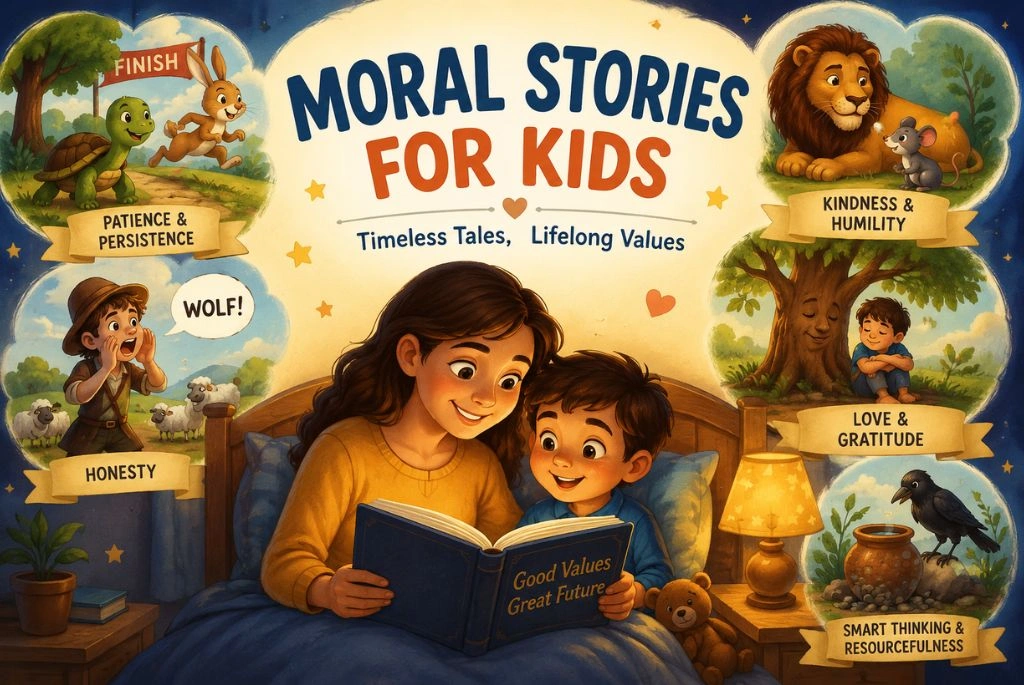
Story 1: The Tortoise and the Hare
Once upon a time, a fast hare challenged a slow tortoise to a race. The hare laughed loudly and sprinted far ahead. Feeling confident, he decided to take a nap under a shady tree. The tortoise never stopped walking. Step by step, slowly and steadily, he crossed the finish line while the hare was still snoring away.
Moral: Slow and steady wins the race. Consistency and effort will always beat talent that is too lazy to show up.
Why kids love it: The underdog wins! Children naturally root for the tortoise, and it teaches them to never give up on themselves, even when others seem ahead.
Story 2: The Boy Who Cried Wolf
A shepherd boy, bored on the hillside, shouted “Wolf! Wolf!” just to trick the villagers into running up the hill. They came rushing, found no wolf, and walked back feeling angry. The boy laughed and did it again the next day. When a real wolf finally appeared, and the boy screamed for help, nobody believed him. Nobody came. He had lost his flock and, more importantly, the trust of everyone around him.
Moral: Honesty is not just a good habit. It is something people depend on. Once trust is broken, it is very hard to rebuild.
Why kids love it: The dramatic ending makes this one stick in a child’s memory. They understand the real cost of lying without needing any explanation from a parent.
Story 3: The Lion and the Mouse
A tiny mouse accidentally woke a sleeping lion. The lion caught him and was ready to eat him. The mouse begged for mercy and promised to return the favor someday. The lion laughed because what could a tiny mouse ever do for the king of the jungle? He let him go. Days later, the lion was trapped in a hunter’s net and roaring in frustration. Who quietly gnawed through the ropes and freed him? The little mouse.
Moral: Never underestimate anyone. Kindness always comes back to you, often in ways you never expected.
Why kids love it: It flips the power dynamic most satisfyingly. It teaches kindness and humility without a single heavy-handed sentence.
Story 4: The Giving Tree
A young boy loved a tree with all his heart. The tree gave him everything: shade to rest in, apples to eat, branches to build with, and he found deep joy in giving. As the boy grew older and kept asking for more, the tree kept giving until only a stump remained. One day, the older man returned, tired and needing only a quiet place to sit. The stump was enough. The tree was happy.
Moral: True love means giving without expecting anything back. Gratitude is the greatest gift you can offer someone who has always cared for you.
Why kids love it: This story is just as meaningful for parents as it is for children. Reading it together often opens a beautiful conversation about love, sacrifice, and saying thank you.
Story 5: The Crow and the Pitcher
On a very hot summer day, a thirsty crow found a pitcher with a little water at the bottom. The water was too deep for his beak to reach. Instead of flying away in defeat, the crow picked up small pebbles one by one and dropped them into the pitcher. The water level slowly rose with each pebble. Finally, the crow could drink.
Moral: Where there is a will, there is always a way. A calm and clever mind can solve problems that strength alone never could.
Why kids love it: It rewards smart thinking. Children feel a real sense of pride when the crow succeeds, and it encourages them to use their own minds when things get difficult.
Also Read: Prayer for Kids in School: Why It Matters and How to Make It a Daily Habit
How to Tell Moral Stories for Kids in a Way That Actually Works
Telling a story well is a skill and a joy. Here are a few tips from our educators at Little Scholar that make storytime even more powerful.
Use your voice and expressions. Be the wolf. Squeak like a mouse. Children are drawn in by performance, and it makes the story come alive.
Pause before the moral. Ask your child what they think will happen next. Ask them what the crow should do. Let them figure it out. The lesson lands much deeper when they discover it on their own.
Connect the story to real life. You can gently say something like “Remember the boy who cried wolf? Is that a little like what happened at school today?” This helps the lesson travel from the story into real situations.
Repeat their favorites. Children learn through repetition. A story heard ten times becomes wisdom that lives in their hearts.
Keep it short for the little ones. For toddlers and very young children between the ages of two and four, choose short moral stories for kids with simple plots, bold characters, and one very clear lesson. Less is always more at that age.
Stories Are Just the Beginning
At Little Scholar Noida, we have been nurturing young minds since 1989. We know from decades of experience that values cannot be taught simply by rules. They must be felt, lived, and experienced. That is why storytelling is woven into our daily routine alongside play-based learning, creative expression, and social development.
Our educators do not just read moral stories for kids out loud. They bring those stories to life through puppets, role-play, art activities, and circle-time conversations. When a child acts out the role of the honest woodcutter or sits patiently like the tortoise, the lesson moves from their ears into their heart.
If you are looking for a playschool in Noida that cares as much about your child’s character as their academics, we would love to welcome your little one.