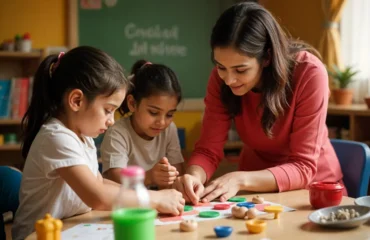
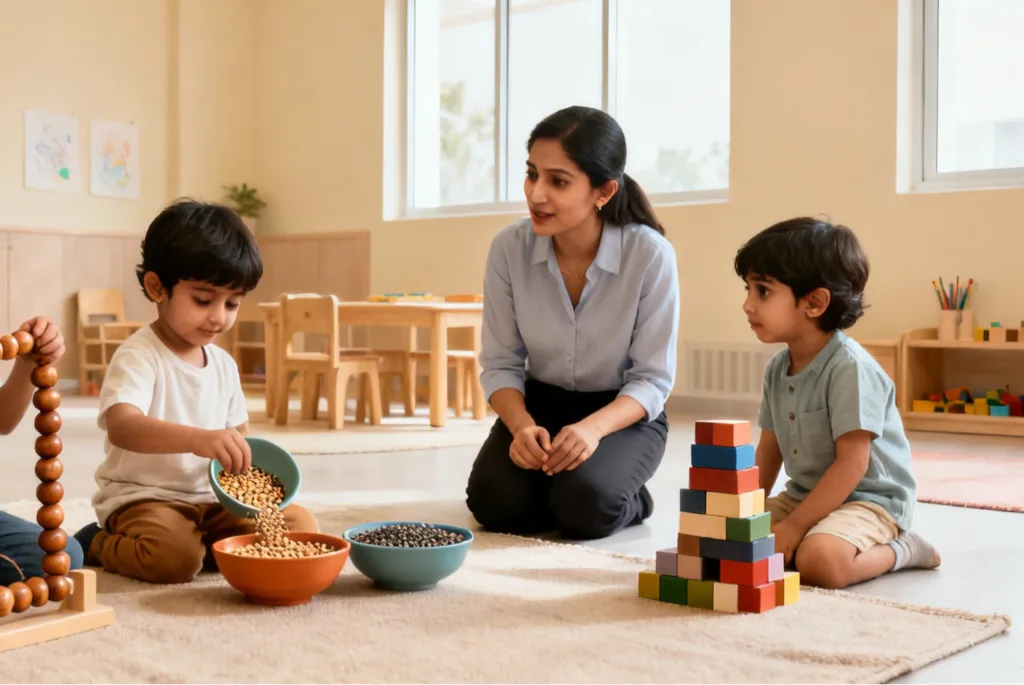
Walk into the nursery wing at Little Scholar Noida and you won’t find children bent over paper for long stretches. What you will see is motion, small hands stacking, sorting, pouring, arguing softly over who gets the red crayon. At this age, a well-planned activity for nursery class does far more than fill time. It sets the emotional tone of the school itself.
Parents often assume learning must look serious to be meaningful. Nursery classrooms quietly challenge that assumption. The real work happening here isn’t about early academics. It’s about orientation, helping children understand how to function in a shared space without feeling lost.
The Purpose Behind Every Activity
In early classrooms, intention hides inside simplicity. A tray of beads may look ordinary. But when a teacher places it carefully and allows children to thread at their own pace, that activity for nursery class is building finger strength, patience, and concentration in one sweep.
Not every moment needs to be explained aloud. Children this age learn by doing, not by listening to lengthy instructions. The best activity for nursery class invites participation without demanding perfection.
Parents evaluating nursery programmes sometimes ask for structured outlines. That’s reasonable. But what matters more is how activities unfold. Is there space for hesitation? Do teachers step in immediately, or allow a child to struggle briefly before helping? Those decisions shape resilience.
Simplicity Often Works Best
There is a quiet confidence in choosing an easy activity for nursery class and trusting it to work. Consider something as basic as transferring grains from one bowl to another. It appears repetitive. Yet repetition builds control. Control builds confidence.
Complexity, especially at this age, can overwhelm. Children thrive when they know what to expect. When a familiar activity for nursery class appears again, they approach it differently each time. A small improvement becomes a visible achievement.
Parents may not always recognise these incremental gains. Teachers do. That is where expertise lies, in seeing progress before it becomes obvious.
Language Development Through Play
Language doesn’t arrive fully formed. It grows through rhythm and repetition. An effective english activity for nursery class might involve acting out a short story rather than reading it straight through. Children absorb tone long before grammar.
In many nursery rooms, you’ll hear fragments of sentences, not perfect, but brave. The right activity for nursery class in language makes children comfortable enough to try.
Correcting too early can silence enthusiasm. Encouraging expression first, refinement later, that sequence matters. Parents observing a classroom should notice whether children speak freely or wait to be called upon.
Also Read: Affordable Pre School in Noida: How to Balance Cost, Care, and Quality Early Learning
Early Numeracy Without Anxiety
Numbers, when introduced carefully, feel natural. A practical maths activity for nursery class may not involve written numerals at all. Counting steps as children line up. Matching objects in pairs. Sorting by size without naming it as “math.”
Children understand patterns before they understand terminology. A thoughtfully designed activity for nursery class introduces quantity as part of daily life, not as a separate subject.
Anxiety around numbers usually begins when learning feels evaluative. In nursery, the goal is familiarity. When numbers appear casually and repeatedly, they become friendly rather than intimidating.
Movement and Coordination
Stillness is not the default state for four-year-olds. Nor should it be. Physical movement is not separate from learning; it anchors it.
An activity for nursery class that involves hopping between coloured circles or balancing along a taped line on the floor develops coordination, yes, but also attention. When children focus on controlling their bodies, they are practising self-regulation.
Music and movement sessions are often where you see the most authentic joy. Energy, when guided instead of suppressed, turns into focus later.
Social Learning Embedded in Activities
Some of the most important lessons in nursery are unplanned. Who waits. Who insists. Who negotiates. A shared activity for nursery class exposes children to difference, different temperaments, different speeds, different reactions.
Teachers do not eliminate every disagreement. They moderate it. Learning to recover from small conflicts prepares children for more complex environments later.
Parents sometimes underestimate how significant this stage is socially. The ability to function in a group begins here, quietly.
The Role of Routine
Routine, at nursery level, is less about discipline and more about reassurance. When children know what follows circle time, they relax. When transitions happen consistently, anxiety reduces.
Each activity for nursery class fits within this broader rhythm. Snack time. Play time. Story time. The order becomes predictable, even when the content shifts.
Predictability builds security. Security supports participation.
What Parents Should Look For
During school visits, it helps to observe not only the activity itself but the response around it.
Does the room feel tense or steady?
Are teachers speaking over children, or with them?
Do children appear absorbed, or distracted?
A meaningful activity for nursery class does not require constant adult correction. It holds attention naturally.
Parents should also notice how teachers respond to different personalities. Some children dive in immediately. Others stand back. Flexibility in approach reflects understanding.
The Bigger Picture
Nursery education is often misunderstood as preparation for formal schooling. It is better understood as preparation for participation, in conversation, in routine, in shared space.
When each activity for nursery class is chosen with intention rather than urgency, children begin associating school with curiosity rather than pressure.
For families in Noida, the most suitable nursery environment is one where activities feel balanced, neither chaotic nor rigid. Where engagement is encouraged, not forced. Where children leave not exhausted, but satisfied.
That steady beginning makes everything that follows easier.