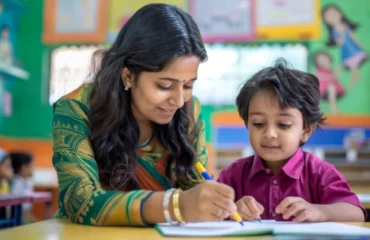
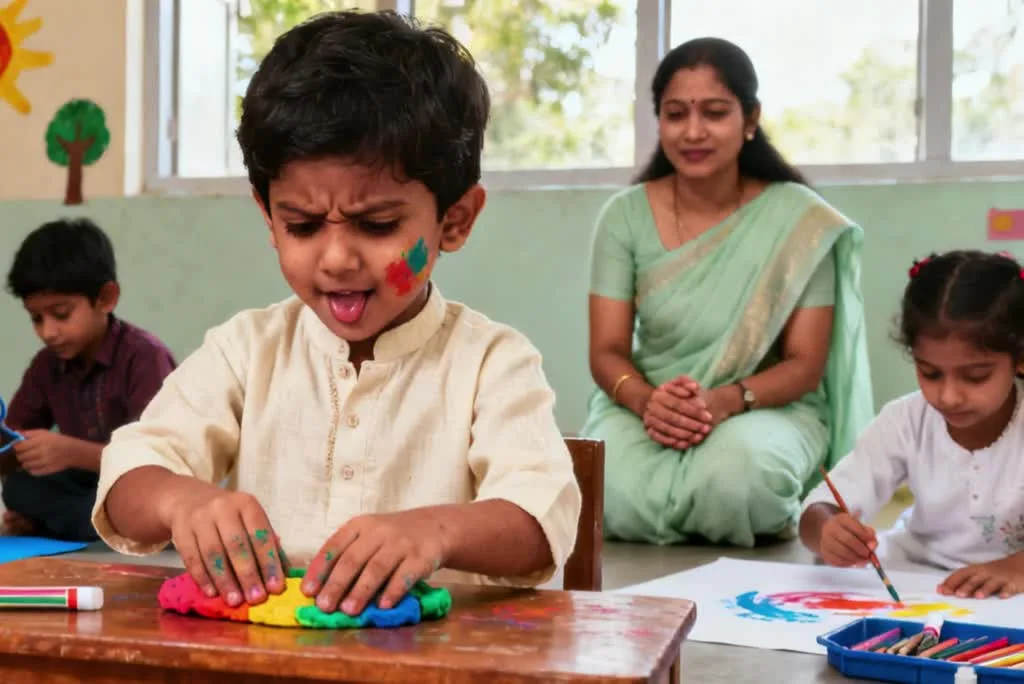
If you stand quietly outside a kindergarten classroom at Little Scholar Noida, the first thing you notice isn’t noise. It’s the focus. A child bending close to paper. Another pressing clay between small fingers with complete seriousness. There is no audience here. Just effort. At this stage, art and craft for kindergarten isn’t decorative. It’s personal.
Parents sometimes look for measurable outcomes when they visit schools. They ask about reading levels or number recognition. Those questions matter. But what often gets missed is how deeply early creativity influences those later milestones. The child who learns to persist through a tricky craft task is learning more than technique. They are learning how to stay with a challenge.
Beyond Decoration: The Real Purpose of Art
A wall filled with painted shapes can look cheerful, but the real work happened before the display. It happened when a child decided which colour to choose. When they realised glue spreads differently than paint. When they adjusted after tearing paper too quickly.
A thoughtful art and craft for kindergarten sessions gives children space to make those decisions themselves. Not every edge needs correction. Not every line needs to be straight. What matters is that the child experiences the process fully.
In some classrooms, finished pieces look identical. In others, they are wildly different. The second approach often signals that art and craft for kindergarten is being used as a thinking tool, not a copying exercise.
The Confidence That Comes from Making
Young children are acutely aware of what they can and cannot do. When they complete something with their own hands, the satisfaction is visible. It may not be loud, but it is steady.
Within art and craft for kindergarten, children confront small frustrations regularly. Scissors slip. Paint spills. Clay cracks. What happens next is important. Do they give up? Or do they try again?
Teachers who allow retrying without rushing in build resilience. Confidence at five does not come from applause. It comes from repetition.
Expression Without Pressure
Children often express ideas in fragments. Sometimes a drawing explains more than a sentence can. That is where art and craft activities for kindergarten serve an essential role.
A child drawing a crowded birthday scene might be processing excitement. Another drawing of careful rows of trees might be drawn in order. These details are not always dramatic, but they are revealing.
In classrooms where art and craft for kindergarten is valued, teachers observe without over-directing. They allow expression to unfold naturally. There is guidance, but not control.
Building Skills Through Texture and Tools
Fine motor control develops quietly. It strengthens through holding brushes, folding paper, threading beads, and pressing clay.
An effective art and craft for kindergarten programme uses materials deliberately. Not for spectacle, but for skill. Clay builds strength in fingers. Tearing paper develops grip variation. Painting across a wide surface encourages shoulder movement.
Parents often associate writing readiness with tracing letters. Yet the groundwork lies here, in these repeated hand movements.
Social Learning Through Shared Creation
Creative work rarely happens alone in kindergarten. Tables are shared. Materials are limited. Conversations happen mid-task.
During art and craft for kindergarten sessions, children practise negotiation without realising it. Who gets the blue crayon first? Can we share the glitter? These are not dramatic conflicts, but they teach patience.
Teachers who step back slightly allow children to navigate these moments. That balance between supervision and independence shapes social growth.
Also Read: Kindergarten Graduation Day: More Than Caps, Gowns, and Photos
Routine and Structure in Creative Work
Creativity flourishes inside predictable boundaries. In structured classrooms, children know the sequence: introduction, making, clean-up.
Routine helps children settle. When art and craft for kindergarten follows a steady rhythm, children relax into the process. They are not wondering what comes next. They are absorbed in what is happening now.
Clean-up is part of learning. Returning brushes. Stacking papers. These small acts build responsibility.
Observing Growth Over Time
If you compare a child’s drawing from the first week of school to one from mid-year, the difference can be subtle but telling. Lines become steadier. Shapes become intentional. Colour choices shift from random to deliberate.
Art and craft for kindergarten provides a visible timeline of development. Not competitive comparison, but individual progression.
Parents who pay attention to this gradual evolution understand that growth at this age is rarely dramatic. It accumulates.
Choosing the Right Environment
For families in Noida evaluating kindergartens, creative sessions offer insight into philosophy.
Are children allowed to experiment, or are they guided step-by-step toward uniform results?
Does the room feel calm during art time, or chaotic? Are teachers patient when something goes wrong?
A school that integrates art and craft for kindergarten meaningfully does not treat it as filler between “serious” lessons. It recognises that creativity strengthens concentration, patience, and problem-solving.
The Bigger Picture
Kindergarten should not feel like rehearsal for academic pressure. It should feel like preparation for participation.
When art and craft for kindergarten is given space and respect, children learn to approach tasks with curiosity rather than fear. They understand that mistakes can be corrected. That effort has value. That ideas can be expressed safely.
Those habits carry forward. Into reading. Into numbers. Into group work. The skills built at the art table rarely stay there.
For parents considering Little Scholar Noida, creative learning is not an extra. It is an indicator of how seriously the school takes early development.