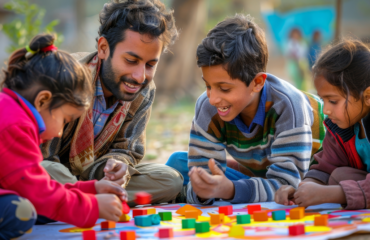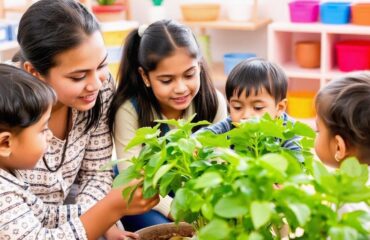
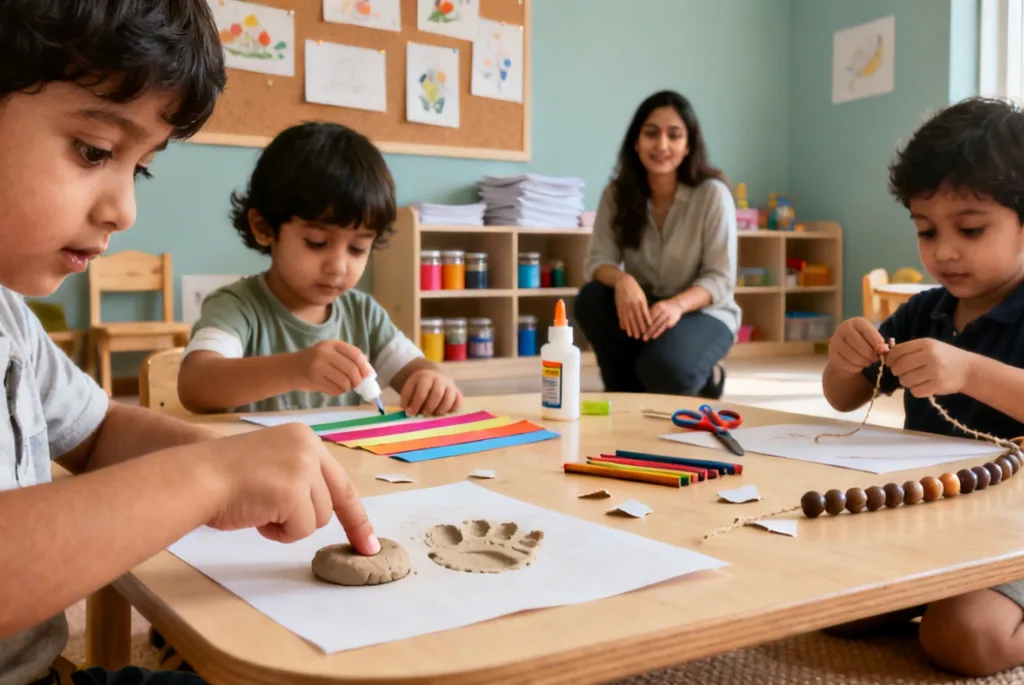
Just before lunch, the preschool rooms at Little Scholar Noida grow unexpectedly quiet. Not silent. Focused. A child is pressing a thumb into clay, studying the mark it leaves. Another is turning a sheet of paper sideways, reconsidering the space. No one calls this “serious work.” But that’s exactly what it is. In these minutes, craft activities for preschoolers are doing something far more important than filling time.
Parents often ask what real learning looks like at four or five. It doesn’t look like lectures. It looks like hesitation before cutting. It looks like trying again after tearing paper unevenly. The right craft activities for preschoolers build that kind of patience, the kind that shows up later in reading, in writing, in sitting with a task instead of abandoning it.
Craft as Cognitive Exercise
There is a difference between being shown what to make and figuring out how to make it. Watch closely and you’ll see it. A child decides whether to place the blue strip on the left or the right. They test glue pressure. They notice when something doesn’t align.
That decision-making is the quiet engine behind craft activities for preschoolers. The table may look messy. The thinking underneath it is not.
In classrooms where every outcome looks identical, the thinking has often been replaced with instruction. In rooms where each piece varies slightly — crooked edges, unexpected colour combinations — you’re usually seeing genuine engagement. Thoughtful craft activities for preschoolers leave space for imperfection.
The Power of Small Struggles
The moments adults instinctively want to fix are often the most useful ones. A smudge. A fold gone wrong. A shape cut too small.
A well-designed easy craft activity for preschoolers doesn’t eliminate those small frustrations. It contains them. It allows a child to feel the mistake without feeling defeated.
Teachers who step back for a few seconds before intervening are making a decision. They’re choosing growth over neatness. That choice changes how children approach difficulty, not just in craft, but in everything.
Language, Imagination, and Craft
The craft table is rarely quiet for long. “This is my rocket.” “No, it’s a mountain.” “It’s both.” Conversations spiral outward from paper and glue.
That’s where art and craft activities for preschoolers connect to language development in subtle ways. When children explain their creations, they’re organising ideas. They’re sequencing events. They’re choosing words to match images.
The best classrooms don’t overcorrect during these explanations. They listen. They might expand a sentence gently, but they don’t take control of the narrative. Craft becomes a doorway into expression.
Texture as Teacher
Preschoolers don’t just see materials. They feel them. Smooth card stock. Rough jute. Soft clay that yields under pressure. Sticky glue that resists spreading evenly.
Strong craft activities for preschoolers use these differences deliberately. Clay strengthens fingers. Threading beads trains coordination. Tearing paper teaches restraint — pull too fast and it rips unevenly.
These experiences don’t announce themselves as preparation for writing. But they are. Fine motor control begins long before formal handwriting practice.
Social Learning at the Craft Table
A craft table is rarely solitary. Materials move back and forth. Opinions are shared without invitation.
“Can I use that next?”
“Look at mine.”
“Help me hold this.”
In these small exchanges, craft activities for preschoolers become social laboratories. Children practise waiting without being told to practise waiting. They practise sharing because resources are limited.
Teachers observe these negotiations carefully. They step in when voices rise too high. Otherwise, they let children find solutions. Social confidence grows in these unscripted moments.
Routine Within Creativity
Freedom works best inside predictable boundaries. In organised preschool rooms, craft follows a rhythm. A short introduction. Time to experiment. A signal for clean-up.
When craft activities for preschoolers happen within this steady structure, children feel secure. They know what comes next. That predictability reduces distraction.
Clean-up is part of the lesson. Returning scissors. Wiping tables. Stacking artwork carefully. Responsibility is woven quietly into creativity.
Tracking Growth Without Pressure
Compare a drawing from the first week of school with one from later in the year. The early version may be broad strokes and scattered shapes. Months later, lines are steadier. Shapes are intentional. Details appear.
Craft activities for preschoolers create a visual timeline of development. Not competitive comparison — personal progression.
Parents who revisit earlier pieces often notice changes they missed day to day. Improvement in attention span. Improvement in control. Improvement in confidence.
Also Read: Activity for Nursery Class: Building Foundations Through Play and Routine
Choosing the Right Preschool Environment
For families in Noida exploring options, watching craft time tells you more than polished presentations ever could.
Are children leaning forward, absorbed? Or glancing around for direction every few seconds? Do teachers hover constantly, or allow space?
A preschool that values craft activities for preschoolers understands that creativity supports cognitive stamina. It doesn’t treat craft as filler between “important” lessons. It sees craft as foundational.
Parents should also look at the finished work displayed. Does it look uniform? Or does each piece reflect a different approach? Variation often signals independent thinking.
The Bigger Picture
Preschool is not about accelerating children toward academic performance. It is about building comfort with effort.
When craft activities for preschoolers are embedded consistently into the day, children develop habits that extend beyond paper and glue. They learn to persist through minor frustration. They learn to revise. They learn that not everything works the first time.
Those habits matter far more than perfect cut edges.
At Little Scholar Noida, creative sessions are not decorative additions. They are part of how children learn to think with their hands before they think with words.
And that kind of thinking lasts.