The first thing that stands out on a weekday morning at Little Scholar Noida is not decor or display boards. It is the pace. Children arrive without being rushed into readiness. A few move toward activities immediately. Others linger, watching. No one seems pushed to perform calmness. That small detail, the absence of urgency, often tells parents more than any brochure ever could.
For many families in Noida, the search for an affordable pre school begins with a spreadsheet. Fees, timings, transport, distance from home. Practical questions lead the way. But once visits begin, something else becomes clear: affordability is only one layer of the decision. The real question is whether cost and care can coexist without tension.
What affordability should really mean
Affordability in early education should not signal stripped-down learning. It should signal thoughtful allocation. An affordable pre school that directs its resources toward trained educators, manageable group sizes, and consistent routines may offer more stability than institutions that prioritise visible excess.
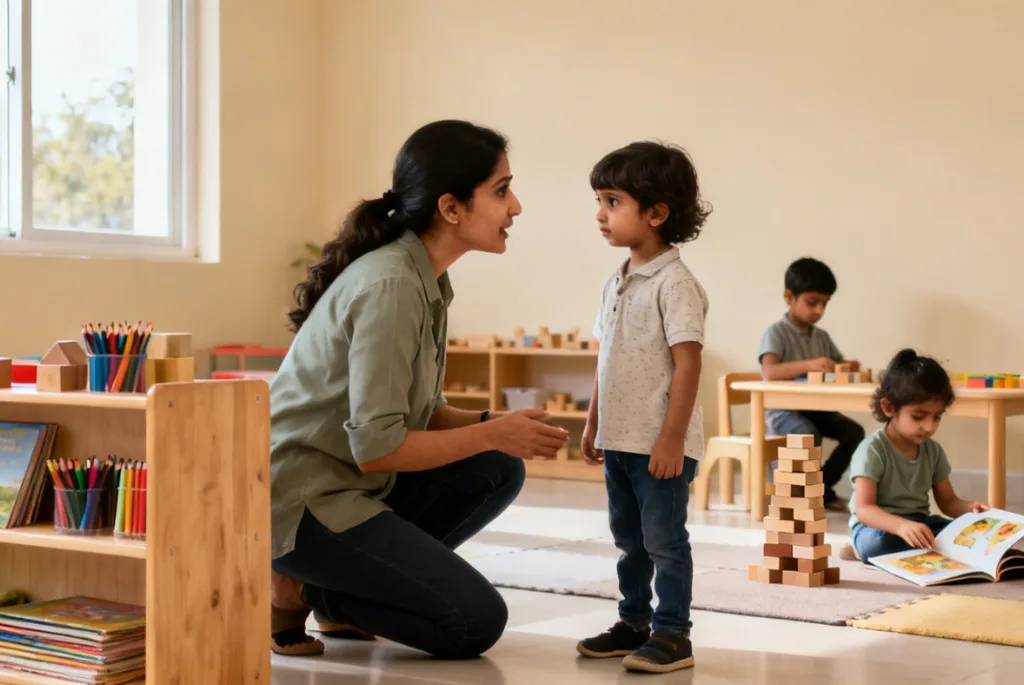
Children at this age do not evaluate interiors. They respond to tone. A steady voice. A predictable sequence. A teacher who kneels instead of calls out instructions from across the room. These details cost far less than elaborate infrastructure, yet they shape daily experience far more deeply.
When parents assess an affordable pre school, the relevant question is not “What extras are missing?” but “What essentials are protected?”
The lifestyle reality for modern Noida families
Noida’s daily rhythm is fast. Workdays stretch. Commutes fluctuate. Extended family may or may not live nearby. In this setting, choosing an affordable pre school is rarely about finding the cheapest option. It is about finding a dependable one.
Parents want to know that while they are at work or managing home responsibilities, their child’s early hours are structured but not rigid, supervised but not controlled. Financial practicality matters, but emotional assurance matters just as much.
Higher education conversations often revolve around return on investment, as seen in discussions about the best affordable pre med schools. Early education operates on different terms. Its returns are measured in comfort with routine, willingness to separate, and gradual independence, none of which appear on a ranking list.
What quality looks like at this age
Quality at the pre-nursery level is rarely loud. It appears in transitions. When an activity ends, does the room unravel, or does it shift smoothly? When a child resists participation, is there negotiation or pressure?
In a strong affordable pre school, children are allowed small pauses. They are not constantly redirected. This restraint requires attentiveness. It cannot be improvised.
Parents visiting an affordable pre school may benefit from observing the edges of the day arrival, snack time, departure. These moments reveal whether the environment relies on strict control or gentle consistency.
Children who appear settled, even if occasionally noisy, are usually in spaces where adult responses are predictable.
The role of teachers in an affordable setting
At this stage, teachers are the curriculum. Young children measure safety by adult behaviour. Consistency builds trust. In an affordable pre school, teacher stability matters more than decorative themes or imported equipment.
A teacher who remains calm when a child cries communicates that emotion is manageable. A teacher who allows a child to attempt a task before intervening communicates confidence.
Affordability should never imply inattentiveness. Families should expect that teachers know their child’s patterns, who hesitates, who leads, who prefers observation first. This familiarity cannot be automated. It grows through daily engagement.
Also Read: Orange Day Activity for Kindergarten: A Colour, a Feeling, a Day Children Remember
Play, routine, and independence
Play in early childhood is not entertainment; it is rehearsal. Through play, children experiment with boundaries and social roles. They repeat conversations they hear at home. They practise waiting, losing, and trying again.
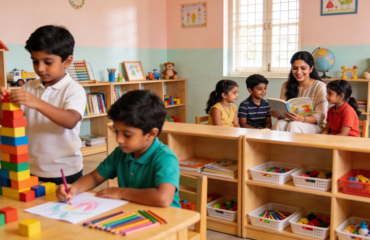
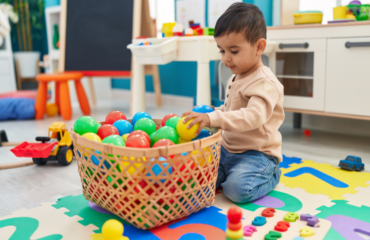
An affordable pre school does not need elaborate play structures to support this. Simple materials, blocks, paper, storybooks, role-play props, are sufficient when teachers guide thoughtfully.
Routine provides the other half of stability. When children understand what follows snack time or circle time, anxiety decreases. Gradually, they begin anticipating steps on their own. Parents often notice the shift at home: a child who insists on putting shoes in the correct place, or who follows a sequence without prompting.
These small changes are often more meaningful than early academic drills.
Making an informed decision
Families comparing options will naturally evaluate fees first. Yet stepping inside an affordable pre school offers more clarity than numbers alone.
Observe how adults respond to hesitation. Notice whether children move confidently within the space. Pay attention to the room’s sound level, not whether it is silent, but whether it feels chaotic or guided.
An affordable pre school that balances structure with warmth rarely needs to advertise aggressively. Its quality shows in the steadiness of its daily rhythm.
Parents may also consider how communication flows. Are updates practical and specific? Is feedback tailored or generic? Transparency often reflects internal organisation.
The bigger picture
Pre-nursery is not preparation for competitive schooling. It is preparation for participation. Children learn how to exist in shared spaces, how to follow a group cue, and how to recover from minor frustration.
An affordable pre school that protects these fundamentals is not offering less. It is offering focus.
For families in Noida, the right choice is often the one where cost feels manageable and the environment feels measured. When those two align, early education becomes less about comparison and more about confidence.