
Every parent knows the feeling. It is a rainy afternoon, your child is bursting with energy, and there is absolutely nothing to do outside. The television has been on for the third hour in a row, and you are quietly wondering if there is a better way to spend this time together.
There is.
Indoor activities for kids are one of the best ways to keep children engaged, creative, and genuinely happy without ever needing to step outside the front door. The best part is that most of these activities do not require expensive toys or fancy supplies. All they really need is a little imagination, some basic household items, and a willing parent or caregiver by their side.
At Little Scholar, the best playschool in Noida, we believe that learning never stops at the school gate. Some of the richest development in a child’s life happens at home, during quiet, unstructured time, when children are free to explore at their own pace, create without judgment, and simply play.
In this blog, we are sharing 10 wonderful indoor activities for fun kids, easy to set up, and genuinely good for your child’s overall growth and happiness.
Why Indoor Activities Matter for Your Child’s Development
Before we dive into the ideas, it is worth taking a moment to understand why purposeful indoor play is so valuable for young children.
When children engage in thoughtful indoor activities, they are not just passing the time. Every time a child builds a tower, paints a picture, or acts out a story, something important is happening. They are building focus, developing fine motor skills, learning to solve small problems, and stretching their imagination in ways that screens simply cannot offer. They are also learning to manage their emotions, whether that is the frustration of a fallen block tower or the joy of finding the last puzzle piece.
Screen time has its place, but it cannot replace the deep, engaged play that comes from building something real or figuring out a challenge on their own. Indoor activities for kids fill that space beautifully, especially on the many days when going outside is simply not possible.
10 Fun Indoor Activities for Kids to Try at Home
1. Building with Blocks or Household Items
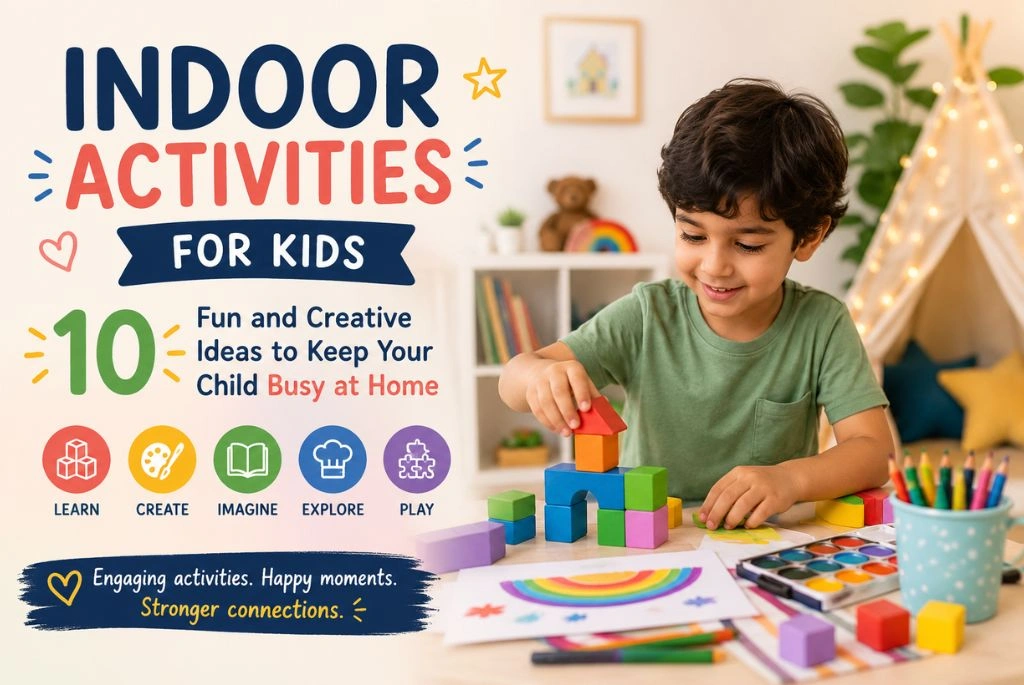
Give your child a pile of wooden blocks, plastic cups, or even old cardboard boxes and watch what happens. Children have a natural drive to build, stack, balance, and knock things down. This simple activity simultaneously develops spatial awareness, logical thinking, and hand-eye coordination. Just sit nearby, show genuine interest, and let their imagination take the lead.
2. DIY Painting and Craft Time
Lay down an old newspaper, hand your child some paints and paper, and step back. Painting is one of those indoor activities for kids that works at almost every age. Toddlers love the sensory pleasure of spreading color. Older children create scenes and characters through their artwork. You can also try finger painting or vegetable stamping with cut potatoes. Do not worry about the mess. It washes off, and the joy is completely worth it.
3. Indoor Treasure Hunts
Hide small objects or little notes around the house and create a simple treasure hunt for your child. Make it as easy or as challenging as their age allows. For younger children, use picture clues. For older ones, write short riddles or directions. Treasure hunts encourage reading, logical thinking, and physical movement, all while keeping children completely absorbed. The look on their face when they find the final treasure is unforgettable.
4. Storytelling and Puppet Shows
Use old socks or paper bags to make simple puppets and let your child put on a show. Start a story and invite them to continue it, or give them a few characters and see where their imagination goes. Storytelling is one of the most powerful indoor activities for kids because it builds language skills, emotional intelligence, and confidence simultaneously. Children who practise telling stories regularly become better speakers and creative thinkers as they grow.
5. Cooking and Baking Together
Invite your child into the kitchen to help with age-appropriate tasks. Younger children can wash vegetables or stir batter. Older children can measure ingredients or roll dough. Cooking together teaches sequencing, cause and effect, and basic maths through measuring. More than that, it gives children a genuine sense of pride when they sit down to eat something they helped make.
6. Indoor Obstacle Courses
Use cushions, pillows, chairs, and strips of tape on the floor to build a simple obstacle course in your living room. Children can crawl under tables, jump over cushions, and balance along a taped line. Physical movement matters indoors just as much as outside. This kind of active play burns energy, improves coordination, and leaves children in a noticeably better mood. Time them and let them try to beat their own score.
7. Puzzles and Board Games
A good puzzle or board game is a classic for a reason. Puzzles build patience, concentration, and spatial thinking. Board games teach children to take turns, follow rules, win gracefully, and handle disappointment. Keep a small collection at home and bring them out on slow afternoons. Even simple games like Snakes and Ladders create real moments of laughter and family togetherness.
8. Reading Aloud Together
Pick a book your child loves and read it aloud together. Use different voices, pause at exciting moments, and encourage your child to guess what happens next. Reading aloud builds vocabulary, sharpens listening skills, and plants a love of stories that grows with the child for life. Even five minutes of reading together each day adds up to something truly meaningful over time.
9. Sensory Play with Everyday Materials
Fill a tray or large bowl with dry rice, sand, water, or dried lentils, and give your child small cups, spoons, funnels, and containers to explore with. Sensory play is deeply calming and absorbing for young children. It helps them explore different textures, practise concentration, and process the world around them through touch.
You can also make simple homemade playdough using flour, salt, water, and a little food coloring. Children can spend a surprisingly long time rolling, cutting, and shaping it into food, animals, faces, or anything their imagination produces.
10. Drawing and Writing Journals
Give your child a plain notebook and call it their very own journal. Younger children can draw pictures of their day, their family, or their favorite animals. Older children can write a few sentences about how they felt, what made them laugh, or what they are looking forward to.
Journaling builds self-expression, reflection, and a comfortable relationship with one’s own thoughts and feelings. It also gently develops writing habits without pressure. Looking back at old entries months later becomes one of the most entertaining and touching things a child and parent can do together.
Read More: Thought of the Day for Kids: Simple Words That Shape Big Futures
A Few Tips to Make Indoor Activities Even Better
Keep things simple. You do not need to plan elaborate setups or spend money on new supplies. The simpler the starting point, the more freely a child can shape the activity in their own direction.
Follow your child’s lead. If they lose interest and want to move on, let them. Children learn best when they are genuinely engaged, not when they feel pressured to continue something that has stopped being enjoyable.
Play alongside them. Even ten minutes of getting down on the floor and actually playing with your child changes the energy of the whole afternoon. Your presence is more valuable than any activity you could set up.
Rotate what you offer. Keep a loose mental list of indoor activities your child enjoys, and cycle through them so nothing feels repetitive. An activity that was ignored two weeks ago can suddenly feel exciting and fresh when it comes back around.